Recruiting hotel staff: A new recruitment solution for hotels in Switzerland

Finding hotel staff has become one of the key challenges in day-to-day operations for many businesses in Switzerland and across the German-speaking world. Vacancies at reception, in service, housekeeping or the kitchen have a direct impact on operations, guest satisfaction and financial stability. At the same time, simply advertising vacancies is no longer enough. Anyone looking to recruit hotel staff needs a process that integrates selection, language, integration and practical support.  This is precisely where a new partnership between talents4.eu and IMConsulting from Brunnen in Switzerland comes in. Together, the partners offer a structured model for recruiting staff for hotels and catering businesses, initially with a focus on Switzerland.

Zwei Mitarbeiter: innen an einer Hotelrezeption und ein Gast sind zu sehen. Durch ein Fenster auf der linken Bildseite sind Berge zu erkennen. Das Bild ist KI-generiert

Why finding hotel staff is becoming increasingly difficult

The pressure on the hospitality industry is very real. According to DEHOGA, in November 2025 there were around 1,097,200 employees subject to social insurance contributions working in the hospitality sector in Germany. At the same time, 17,667 vacancies were still reported to the Federal Employment Agency in January 2026. This shows that the sector remains labour-intensive, and the demand for suitable staff remains high. (dehoga-bundesverband.de)

Furthermore, the bottleneck lies not only in the number of applications, but above all in the fit. In its skilled labour shortage analysis, the Federal Employment Agency describes how there are professions in which it is relatively difficult to fill advertised vacancies. For hotels, this means in practice that not every application matches the job profile, and not every hire proves stable in the long term. Anyone looking to recruit hotel staff must therefore place greater emphasis on the quality of selection, clarity of expectations and support. (Statistics from the Federal Employment Agency)

Hotel staff for Switzerland: recruitment doesn’t end with the offer

In Switzerland in particular, there is an additional factor at play. HotellerieSuisse points out that the lack of staff accommodation in tourist communities further exacerbates the shortage of skilled workers. Even if hotels find suitable candidates, the appointment may fail because no suitable accommodation is available locally. Recruitment must therefore be thought through further: not just up to the employment contract, but right through to the candidate’s actual arrival at the workplace and in their new environment. (Hotellerie Suisse) This is precisely where the new partnership between talents4.eu and IMConsulting comes in. The service offering encompasses not only the recruitment of staff for hotels and catering establishments, but a comprehensive, modular process. This includes clarifying requirements, targeted marketing, screening and pre-selection, selection procedures, language and integration courses, help with finding accommodation, support with bureaucratic matters, and guidance for both employees and employers. Interpreters are available at every stage of the project.

How hotels can find hotel staff more effectively with a structured process

For hotel businesses, this approach is particularly relevant because it combines operational relief with improved planning. The first step is to clarify requirements precisely: which position needs filling, what qualifications are required, and what working conditions does the business offer? Only once these questions have been clearly answered can recruitment truly function in a targeted manner. It is precisely this logic that underpins the concept of talents4.eu and IMConsulting.

Building on this, suitable candidates are approached in a targeted manner, followed by a structured pre-selection process. From comparable recruitment projects by talents4.eu, we know that the process relies on systematic screening, assessing motivation, interviews, the use of interpreters and accompanying language preparation. This is particularly important for hotels, as misunderstandings during recruitment often lead to candidates dropping out, dissatisfaction or high staff turnover later on.

Another key advantage lies in integration support. Anyone wishing to find and retain hotel staff in the long term must actively support new employees as they settle in. This includes language support, organisational assistance and practical help with issues such as accommodation, documents or everyday matters. It is precisely these elements that are an explicit part of the service offered by swiss-hospitality-recruiting. This sets the model apart from traditional recruitment agencies, which often conclude their involvement once the contract has been signed.

Man sieht eine Mitarbeiterin in einer Gaststätte, die ein Tablett mit Getränken trägt. Das Bild ist KI generiert.

The concrete benefits for hotels

For decision-makers in hotels, such a recruitment approach brings several direct benefits. Firstly, internal workload is reduced because the job profile, candidate search, shortlisting and support are bundled into a coordinated process. Secondly, the likelihood of a good fit increases because requirements and expectations are communicated more clearly from the outset. Thirdly, the chances of team stability improve because onboarding is not left to chance. This is a significant difference, particularly in times of skills shortages. This is particularly relevant for hotels in Switzerland, as staff recruitment today is not merely a matter of recruitment but a strategic management task. Anyone seeking to find hotel staff needs reach, selection expertise and integration support. When additional factors such as staff accommodation or language barriers come into play, it becomes clear why a modular process is significantly more robust than a purely individual placement. (Hotellerie Suisse)

Finding hotel staff rather than just filling vacancies

The new partnership between talents4.eu and IMConsulting is therefore more than just another recruitment service. It responds to the reality of an industry in which hotels need to fill vacancies not only more quickly, but above all more sustainably. Anyone looking to find hotel staff today needs a clear process, from assessing requirements through selection to linguistic and practical integration. It is precisely this synergy that makes the new model attractive for hotels in Switzerland.


Ihre Ansprechpartner

Hotelpersonal finden: Neue Recruiting-Lösung für Hotels in der Schweiz

Personal für Hotellerie, Gastronomie und Tourismus zu finden, ist für viele Betriebe – gerade im Alpenraum – zu einer zentralen Herausforderung geworden. Unbesetzte Stellen in Küche, Service, Housekeeping, Front Office, Restaurantleitung, Facility und Hospitality-Management wirken sich unmittelbar auf Abläufe, Gästezufriedenheit und damit auch auf die wirtschaftliche Situation eines Betriebes aus.

Aktuell bewegt sich die Zahl der offenen Stellen im Gastgewerbe laut Bundesagentur für Arbeit bei über 17.000. Insgesamt zählt sie derzeit etwa 1,1 Mio. sozialversicherungspflichtig Beschäftigte – und wird auch weiterhin sehr personalintensiv bleiben.

Dazu kommt: In vielen Fällen reicht es nicht mehr aus, einfach nur eine offene Stelle auszuschreiben. Wer Hotelpersonal finden will, braucht einen strukturierten Prozess, der Auswahl, Sprachkenntnisse, die langfristige Integration und die praktische Begleitung zusammendenkt.

Zwei Mitarbeiter: innen an einer Hotelrezeption und ein Gast sind zu sehen. Durch ein Fenster auf der linken Bildseite sind Berge zu erkennen. Das Bild ist KI-generiert

talents4.eu und Swiss Hospitality Recruiting: Kooperation für strukturierte Personalsuche

Genau hier setzt eine neue Kooperation von talents4.eu und Swiss Hospitality Recruiting der IMConsulting GmbH aus Brunnen in der Schweiz an.

Gemeinsam bieten die Partner ein strukturiertes Modell für die Gewinnung von Personal für Hotels und Gastronomiebetriebe an, zunächst mit Schwerpunkt Schweiz und deutschsprachiger Alpenraum. Besonderer Wert wird dabei auf folgende Aspekte gelegt:

  • Branchenverständnis
    Wir kennen die Anforderungen von Hotellerie, Gastronomie und touristischen Betrieben – vom kleinen familiengeführten Haus bis zur Hotelgruppe.
  • Strukturierte Vorauswahl
    Wir prüfen Qualifikation, Motivation, Sprachstand, Verfügbarkeit, Belastbarkeit und kulturelle Passung.
  • Realistische Suchprofile
    Wir helfen dabei, Anforderungen klar zu definieren und zwischen Muss-Kriterien, Entwicklungspotenzial und wünschenswerten Zusatzqualifikationen zu unterscheiden.
  • Entlastung im Recruitingprozess
    Sie konzentrieren sich auf Ihren Betrieb. Wir unterstützen Sie bei Suche, Vorauswahl und Abstimmung mit geeigneten Kandidaten und unterstützen diese mit weiteren Qualifizierungsmaßnahmen. 

Das Angebot von talents4.eu und Swiss Hospitality Recruiting umfasst also nicht nur die Anwerbung von Personal für Hotels und Gastronomiebetriebe, sondern einen modularen Gesamtprozess. Dazu gehören die Klärung der Anforderungen, gezieltes Marketing, Sichtung und Vorauswahl, Auswahlverfahren, Sprach- und Integrationskurse, Hilfe bei der Wohnungssuche, Unterstützung bei bürokratischen Angelegenheiten sowie die Begleitung von Arbeitnehmern und Arbeitgebern. In allen Projektschritten stehen Dolmetscher:innen zur Verfügung.

Herausfordernder Personalmarkt, konkrete Lösungen

Der Personalmarkt in der Hotellerie und Gastronomie bleibt auch in Zukunft herausfordernd. Viele Betriebe suchen verlässliche Mitarbeitende für operative Positionen, saisonale Einsätze oder langfristige Management-Anstellungen.

Gleichzeitig gibt es gerade in Spanien gut ausgebildete und motivierte Kandidatinnen und Kandidaten, die eine berufliche Perspektive im deutschsprachigen Raum suchen. Die Kooperation von talents4.eu und Swiss Hospitality Recruiting reagiert gezielt auf die Realität einer Branche, in der Hotels offene Stellen nicht nur schneller, sondern vor allem nachhaltiger besetzen müssen. Wer heute Hotelpersonal finden und binden möchte, braucht einen klaren Prozess von der Bedarfsklärung über die Auswahl bis hin zur sprachlichen und praktischen Integration. Genau dieses Zusammenspiel macht das neue Modell für Hotels im gesamten deutschsprachigen Alpenraum so interessant.

Man sieht eine Mitarbeiterin in einer Gaststätte, die ein Tablett mit Getränken trägt. Das Bild ist KI generiert.

Ihre Ansprechpartner

Studierende führen das Einstiegsinstrument (ESI) zur beruflichen Orientierung durch (ENGLISH BELOW)

Als studentische Hilfskräfte bei der TALENTBRÜCKE blicken wir auf eine Saison voller ESI-Tage zurück, in der wir zahlreiche Schülerinnen und Schüler (SuS) als Team mit verschiedenen Professionen begleiten und mit ihnen den Einstieg in ihre berufliche Orientierung gestalten durften. Das Ziel des ESI ist, gemeinsam mit den SuS ihre individuellen Stärken zu erkunden, die sie als Ressource für ihre weitere Laufbahn kennenlernen und nutzen können. Die SuS erhalten von den Begleitpersonen der TALENTBRÜCKE zu Beginn des Tages einen Stärken-Radar, in dem ihre neu entdeckten Fähigkeiten festgehalten werden können.

Mit spielerischen Eisbrechern und der Klärung von Erwartungen an den Tag starten wir die Entdeckungsreise zu den Stärken der SuS – dabei ist es uns wichtig, deutlich zu machen, dass es an diesem Tag kein Richtig und kein Falsch gibt. Alle haben ausreichend Möglichkeit, um sich zu beteiligen und jede:r hat eine unterschiedliche Persönlichkeit, die an diesem Tag Platz finden und gewürdigt werden soll. Persönliche Vielfalt und Neugier stehen am ESI-Tag im Vordergrund.

Der Großteil des Tages besteht im Bearbeiten und Lösen von zwei Aufgaben, die die SuS in Kleingruppen bewältigen. Die erste Aufgabe „Helfen und Planen“ befasst sich mit der Gestaltung eines Events, die zweite Aufgabe „Bauen und Gestalten“ ist praktisch angelegt und bietet Raum für Kreativität und Fantasie bei der Konstruktion einer Brücke. Beide Aufgaben sind so konzipiert, dass alle SuS an jedem Aufgabenschritt teilnehmen können, ganz nach Fähigkeiten und Interessen. Die Individualität der SuS ist für uns der Katalysator unseres eigenen Lernens. Praxisnahe Erlebnisse sind für uns, die aus den Bereichen Psychologie, Lehramt, Soziale Arbeit und Erziehungswissenschaften kommen, eine wertvolle Erfahrung. Als Studierende können wir systematische Verhaltensbeobachtung erproben und verbessern, in der wir vor Beginn des ESI von der TALENTBRÜCKE geschult worden sind.

Insbesondere können wir uns als Studierende mit verschiedenen Gruppendynamiken auseinandersetzen, die uns die Möglichkeit bieten, an Herausforderungen im Austausch mit den SuS zu wachsen. Außerdem lernen wir Moderationsskills in flexiblen Situationen anzuwenden und uns auf die SuS einzulassen, indem wir ihren Input und das Feedback in jede Aufgabe versuchen miteinzubauen.

Beim ESI begegnen auch die Studierenden beruflicher Orientierung neu

Obwohl das ESI einem strukturierten Ablauf folgt, bleibt immer Platz dafür, dass die SuS uns und sich selbst mit spontanen und kreativen Vorschlägen überraschen. Zwischen den Aufgaben und über den Tag verteilt gibt es ausreichend Pausen, die die SuS zusammen verbringen – besonders beliebt sind kleine Kickerturniere oder, in den kalten Monaten, Schneeballschlachten. Am Ende der Durchführung ist es für uns wichtig, dass die SuS einen erweiterten bleibenden Eindruck von sich selbst gewinnen konnten. Sie nehmen am Ende des Tages den Stärken-Radar mit nach Hause, der sie durch die weiteren Schritte der beruflichen Orientierung begleiten soll. Die entdeckten Stärken sollen Sicherheit und Vertrauen geben. Mit dem Stärken-Radar können sie sich stets darauf verlassen, dass sie zahlreiche Fähigkeiten besitzen, die sie genauso vielfältig einsetzen können. Obwohl wir als Begleitpersonen die SuS nur an einem Tag begleiten, spiegeln sie uns oft wider, dass genau dieser außerschulisch gewählte Rahmen ihnen positive Bekräftigung schenkt. So erkennen auch wir in jeder Durchführung, dass das ESI ein wichtiger Tag in ihrer persönlichen Entwicklung ist und uns wird bewusst, dass selbst die kurzzeitige Betreuung der SuS einen wichtigen Einfluss auf ihr Selbstbild nimmt.

Abgesehen von beruflichen Ressourcen, die wir aufbauen sind auch und insbesondere die kollegialen Kontakte, die wir untereinander knüpfen, von ganz besonderer Bedeutung. Untereinander lernen wir, uns Hilfe voneinander zu holen, um miteinander Schwierigkeiten des Alltags im ESI zu meistern. Wir stellen uns auf neue Menschen ein, mit denen wir sehr intensive Tage verbringen, an die sich viele Ehemalige der TALENTBRÜCKE herzlich gern zurückerinnern.

Für manche von uns endet diese Saison mit dem Ausblick auf das Studienende, andere bleiben für ein weiteres Jahr – für die lehrreiche und aufregende Zeit möchten wir uns bei der TALENTBRÜCKE bedanken!

Student assistants conduct the ‘Einstiegsinstrument zur beruflichen Orientierung’ (Entry-Level Instrument ; ESI) for career orientation

As student assistants at  TALENTBRÜCKE, we look back on a season full of ESI days, during which we had the opportunity to support numerous students and help them take their first steps in their very own career orientation. The goal of the ESI is to explore students’ individual strengths together with them, so they can recognize and utilize these as resources for their future careers. At the start of the day, the students receive a Strengths Radar from the TALENTBRÜCKE, where they can record their newly discovered skills.

Student assistants conduct the ‘Einstiegsinstrument zur beruflichen Orientierung’ (Entry-Level Instrument ; ESI) for career orientation

As student assistants at  TALENTBRÜCKE, we look back on a season full of ESI days, during which we had the opportunity to support numerous students and help them take their first steps in their very own career orientation. The goal of the ESI is to explore students’ individual strengths together with them, so they can recognize and utilize these as resources for their future careers. At the start of the day, the students receive a Strengths Radar from the TALENTBRÜCKE, where they can record their newly discovered skills.

We begin the journey of discovering the students’ strengths with playful icebreakers and by clarifying expectations for the day—it is important to us to highlight that there is no right or wrong on this day. Everyone has ample opportunity to participate, and each person has a unique personality that should be given space and recognized on this day.

Personal diversity and curiosity take center stage on ESI Day

Most of the day is spent working on and solving two tasks that the students tackle in small groups. The first task involves helping plan an event; the second task is hands-on and allows for creativity and imagination in building a bridge. Both tasks are designed so that all students can participate in every step, according to their abilities and interests. For us, the students’ individuality serves as the catalyst for our own learning. Practical experiences are invaluable to us, as we come from the fields of psychology, teacher training, social work, and educational sciences. As student assistants, we can test and refine systematic behavioral observation, a skill in which we were trained by TALENTBRÜCKE prior to the start of the ESI.

In particular, we can engage with various group dynamics, which offer us the opportunity to grow through challenges in our interactions with the students. Additionally, we learn to apply presenting skills in flexible situations and to engage with the students by incorporating their input and feedback into every task.

At ESI, student assistants also gain a fresh perspective on career orientation

Although ESI follows a structured program, there’s always room for students to surprise us—and themselves—with spontaneous and creative ideas. Between activities and throughout the day, there are plenty of breaks that students spend together—mini football tournaments are especially popular, as are snowball fights during the colder months. At the end of the program, it is important to us that the students have gained a broader, lasting impression of themselves. The students take the Strengths Radar home with them, which can support in guiding them through the next steps of their career exploration. The strengths they discover are intended to give the students confidence and self-assurance. With the Strengths Radar, they can always rely on the fact that they possess numerous skills that they can apply in just as many diverse ways. Although we, as student assistants, only accompany the students for one day, they often reflect back to us that it is precisely this extracurricular setting that provides them with positive reinforcement.

In this way, we too recognize with each session that the ESI is a significant milestone in their personal development, and we realize that even our brief time working with the students has a significant impact on their self-image.

Apart from the professional skills we develop, the collegial relationships we build with one another are also—and especially—of particular importance. We learn to support one another in overcoming the daily challenges of the ESI. We adapt to new people with whom we spend very intense days that many former TALENTBRÜCKE employees fondly remember. For some of us, this season ends with the prospect of graduation; others will stay for another year—we would like to thank TALENTBRÜCKE for this educational and exciting time.

Als Praktikantin im internationalen Projektmanagement bei der TALENTBRÜCKE (English below)

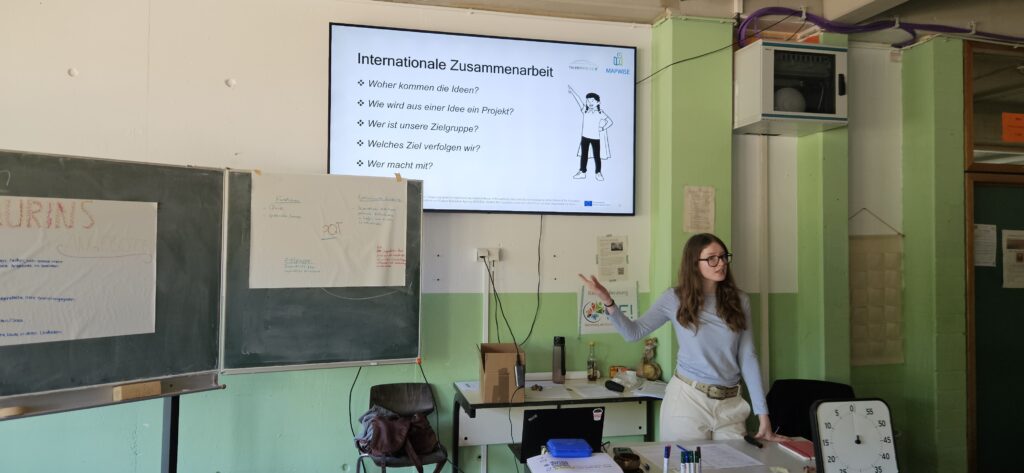
Von Maren Schmidt – Wie ist es eigentlich, als Praktikantin im internationalen Projektmanagement zu arbeiten? Meine erste Antwort darauf wäre wahrscheinlich: abwechslungsreicher, schneller und verantwortungsvoller, als ich es jemals erwartet hätte.

Schon in den ersten Tagen bei der TALENTBRÜCKE wurde schnell klar, dass hier niemand lange „nur zuschaut“. Stattdessen ging es direkt mitten hinein in den Antragsprozess für Erasmus+ Projekte. Was anfangs noch wie ein komplett neues Themenfeld wirkte, entwickelte sich schnell zu einem echten Learning-by-Doing-Erlebnis. Besonders motivierend war dabei zu sehen, dass eigenes Feedback und Ideen nicht einfach nur gesammelt, sondern tatsächlich in reale Projektanträge übernommen wurden.

Als Praktikant im Projektmanagement ist Flexibilität das A und O

Die ersten Wochen waren intensiv – und genau das hat sie so spannend gemacht. Zwischen Recherche zu Erasmus+-Richtlinien, Studien und Datengrundlagen, Workshopentwicklung, Expert:innen-Interviews und Dissemination wechselten die Aufgaben teilweise im Stundentakt. Oft wurde parallel an mehreren Projekten gearbeitet, wodurch kein Tag wirklich dem anderen glich. Gerade diese Dynamik und die enge Zusammenarbeit im Team prägten das dreimonatige Praktikum.

Außerdem hat sich mein Blick auf die EU und europäische Zusammenarbeit stark verändert. Hinter Erasmus+ stehen nicht nur Förderprogramme, sondern vor allem engagierte Menschen aus ganz unterschiedlichen Bereichen, von Lehrer:innen bis Unternehmer:innen, die gemeinsam an innovativen Ideen und Projekten arbeiten.

Rückblickend habe ich im Praktikum nicht nur fachlich viel gelernt, sondern vor allem gelernt, selbstständig mit komplexen Anforderungen und Unsicherheiten umzugehen. Vor allem aber habe ich erlebt, wie spannend internationale Projektarbeit sein kann, wenn man von Anfang an aktiv eingebunden wird.

Internationale Projekte – Ihr Ansprechpartner

Steffen Leist

Steffen Leist

Projektleiter Internationale Projekte

As an intern in international project management at TALENTBRÜCKE

By Maren Schmidt – What is it actually like to work as an intern in international project management? My first response would probably be: more varied, fast-paced and demanding than I ever expected.

Right from my first few days at TALENTBRÜCKE, it quickly became clear that nobody here just ‘stands on the sidelines’ for long. Instead, I was thrown straight into the application process for Erasmus+ projects. What initially seemed like a completely new field quickly turned into a real ‘learning by doing’ experience. It was particularly motivating to see that my own feedback and ideas weren’t simply collected, but were actually incorporated into real project applications.

As a project management intern, flexibility is essential

The first few weeks were intense – and that’s exactly what made them so exciting. Between researching Erasmus+ guidelines, studies and data sources, developing workshops, interviewing experts and dissemination, tasks sometimes changed every hour. We often worked on several projects simultaneously, meaning no two days were really alike. It was precisely this dynamic and the close teamwork that characterised the three-month internship.

Furthermore, my view of the EU and European cooperation has changed significantly. Behind Erasmus+ lie not only funding programmes, but above all committed people from a wide variety of fields, from teachers to entrepreneurs, who work together on innovative ideas and projects. Looking back, I not only learnt a great deal professionally during the internship, but above all I learnt to deal independently with complex challenges and uncertainties. Above all, however, I experienced just how exciting international project work can be when you are actively involved from the very start.

Datenschutz-Übersicht

Diese Website verwendet Cookies, damit wir dir die bestmögliche Benutzererfahrung bieten können. Cookie-Informationen werden in deinem Browser gespeichert und führen Funktionen aus, wie das Wiedererkennen von dir, wenn du auf unsere Website zurückkehrst, und hilft unserem Team zu verstehen, welche Abschnitte der Website für dich am interessantesten und nützlichsten sind.

Alle Informationen zum Datenschutz